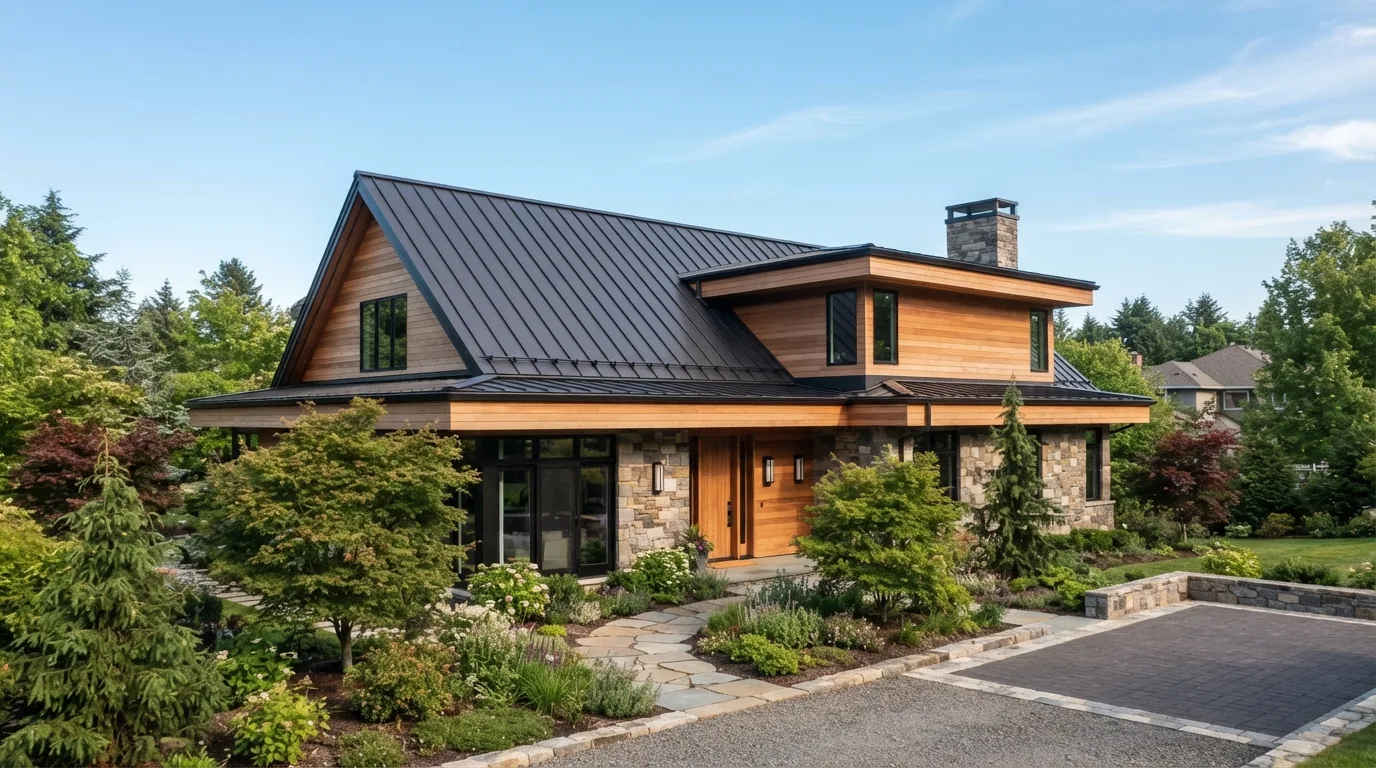
Standing seam or exposed-fastener panels
Most metal roofing around Sacramento County falls into two families, and they behave differently for decades after the job is done.
- Standing seam. Panels lock together at raised seams, and the clips that hold them down sit under the seam, out of the weather. No screw goes through the face of the panel. It costs more up front and asks for little upkeep.
- Exposed-fastener panels. Corrugated and ribbed panels screwed through the face, with a rubber washer under each screw head to seal the hole. They cost less to put on, and they need more looking after over the years.
That upkeep is mostly the screws. One fastener maker puts it plainly: once the screws on a roof pass about 20 years, treat them as living on borrowed time, and most won't make it past 30. The washers harden in the sun, the screws loosen as the panels expand and shrink, and water finds the hole.
Houses, barns and shops
On the Elk Grove tracts, metal shows up as a choice on a house re-roof. Out in Wilton, Sheldon and Franklin, it's more often already on the barn, the shop or the equipment cover, and the call is about a leak or a section of panels that has rusted or blown loose.
Say on the call which building it is, roughly how big, and whether the panels sit on a solid deck or straight on purlins. A shop roof and a house roof are measured, priced and permitted differently, and that first answer decides who comes out.
Weight, fire rating and how long it lasts
- Weight. The Metal Construction Association puts metal roofing at about 0.7 to 1.3 pounds per square foot, against roughly 2 to 4 for asphalt shingle and 6 to 14 for concrete and clay tile. That's why metal can sometimes go where tile can't without structural work.
- Fire. Metal roofs carry a Class A fire rating, the highest there is.
- Service life. The Metal Roofing Alliance gives 30 to 50 years and more. The panels usually outlast the screws, washers and sealant, which is why fastener work is a normal part of owning an older panel roof.
Title 24 on a metal re-roof
California's cool roof rules apply to metal like any other covering. The weight exemption only covers roofs of 25 pounds per square foot or more, and metal is around one. So a steep-slope house re-roof in this climate zone has to use a product rated at an aged solar reflectance of 0.20 and thermal emittance of 0.75 (or an SRI of 16), unless the house qualifies another way, such as R-38 ceiling insulation or no ducts in the attic.
Many painted metal finishes are rated well inside those numbers. Bare, unpainted metal is a closer call because it gives off heat poorly, so the rule is to check the exact product in the Cool Roof Rating Council listing. The Title 24 cool roof guide covers the alternatives in detail.
Repairing a metal roof
Most metal roof leaks are at a detail, not in the middle of a panel: a screw that has backed out, a washer that has cracked, sealant at a lap that has let go, or the flashing where the roof meets a wall, a vent or a skylight. On the visit your roofer checks those first.
- Fastener work. Loose or failed screws get replaced with new ones, sometimes a size up to bite fresh metal.
- Laps and trim. Old sealant comes out before new goes in. New sealant over old tends to fail at the same spot.
- Oil canning. Waviness in the flat part of a panel is usually cosmetic. It comes from how the panel was formed and fastened, and nobody can promise a roof will never show it.
Rust through a panel, or a section that has blown loose, means new panels. When that spreads across the roof, replacing it starts to make more sense than chasing it.
What sets the price
Fixr's January 2026 national figures put standing seam at about $7 to $30 a square foot installed and corrugated panels at about $3.50 to $26. The Metal Roofing Alliance puts metal at roughly two to three times the cost of an asphalt shingle roof. Those ranges are wide because the job varies that much: panel type and gauge, roof size and pitch, how many valleys and penetrations there are, whether the old roof comes off, and the trim and flashing.
Not your final price. These are published ranges and can change for your roof. The final price comes in writing after the inspection.
Your number comes from the visit, in writing, with the panel, the color and the trim named. For shingle and tile prices to compare against, see what a new roof costs in Elk Grove.
Metal roofing questions
How long does a metal roof last?
The Metal Roofing Alliance gives 30 to 50 years and more for the panels. On an exposed-fastener roof, plan on the screws and washers needing attention well before that, often somewhere past the 20-year mark.
Can metal go over my old shingles?
Sometimes, since metal adds very little weight. Elk Grove still requires a full tear-off where the old roof is water soaked or too far gone to be a sound base, so your roofer checks the decking before anything is decided.
Does a metal roof need a permit?
Yes, once the work covers more than 100 square feet inside Elk Grove, the same as any other re-roof. Outside the city, the county or the city your parcel sits in issues it.
What color can I pick?
On a house re-roof, the color has to meet the cool roof rules or the house has to qualify another way, such as R-38 ceiling insulation. Many painted metal colors are rated for it; the written price should name the exact product and color.