Why this matters more here than the brochures suggest
Most roof ventilation advice is written for climates where the concern is winter moisture and ice damming. Neither applies in Elk Grove. What applies is months of sustained heat, with afternoon temperatures above 100 degrees for long stretches of the summer.
An attic under a dark roof in those conditions runs far hotter than the outside air. That heat sits directly against the underside of the roof deck and the shingles fastened to it, and it does not stop at sunset, because the assembly holds heat for hours. Asphalt ages by losing the volatile oils that keep it flexible, and heat is what drives them off. A roof that is cooking from underneath reaches the end of its life earlier than the identical roof next door with a properly ventilated attic.
There is a second cost you pay monthly. A superheated attic radiates into the ceiling below it, which is why upstairs rooms stay uncomfortable into the evening and the air conditioning runs longer than it should.
Intake and exhaust have to balance
This is the part that gets missed, and it is the reason a lot of ventilation work achieves nothing. Attic ventilation is not a quantity of vents. It is a flow: cool air in low, hot air out high, moving continuously.
Intake is at the eaves, usually soffit vents. Exhaust is at or near the ridge. Both halves need roughly equivalent free area, and the intake half is the one that is commonly starved, because it is out of sight and easily blocked.
The most common fault in a house this age
Blown-in attic insulation pushed into the eaves, covering the soffit vents from inside. The vents look fine from the driveway and pass no air at all. Baffles are supposed to hold the insulation back from the eave, and they are frequently missing or crushed. This is worth checking before anyone sells you more exhaust vents.
Exhaust options, and what suits which roof
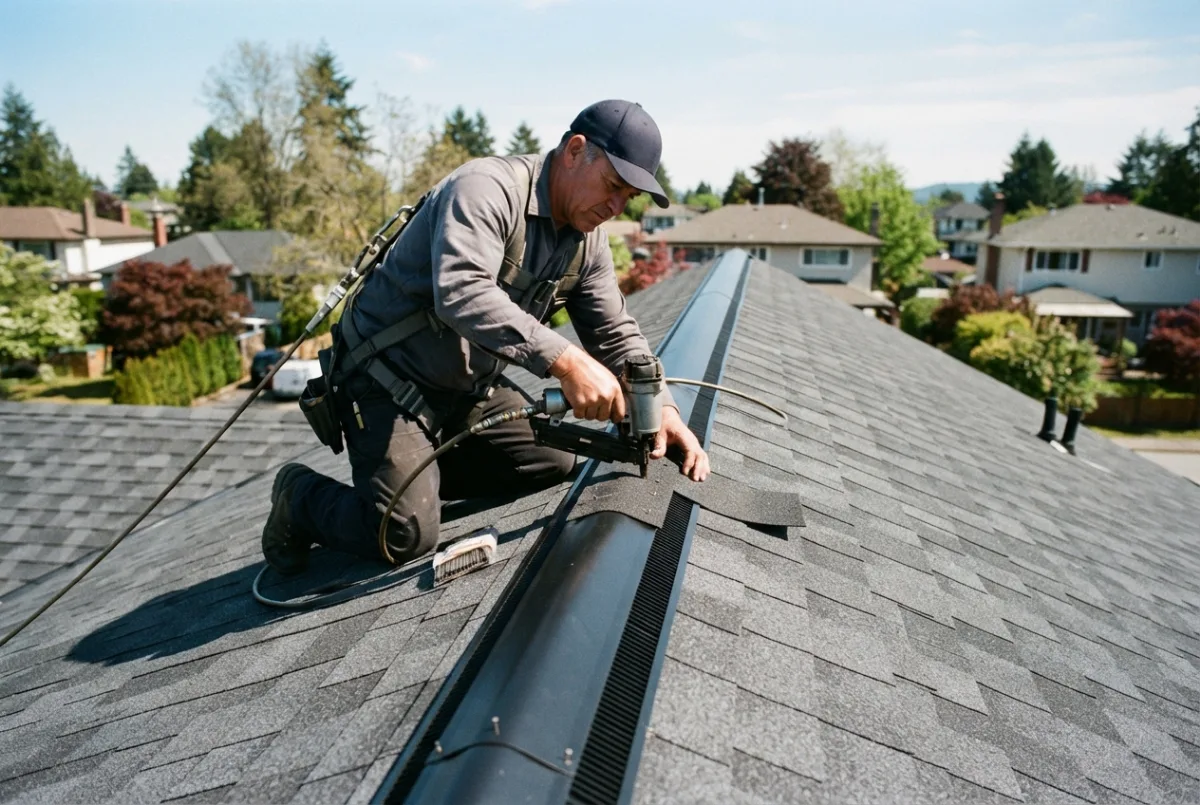
- Ridge vent. A continuous vent along the peak, so exhaust happens across the whole ridge rather than at points. Generally the best option on a shingle roof with a reasonable ridge length, and it is close to invisible from the ground.
- Low-profile field vents. Flat vents set into the roof field below the ridge. The usual solution on tile, where a continuous ridge vent is awkward, and much less obtrusive than the alternatives.
- Static box vents. The simple hooded vents seen on older roofs. They work, but they ventilate a limited area each, so you need enough of them.
- Turbines. The spinning ones. Effective when there is wind, which in this valley is not constant, and they are mechanical parts on a roof, which eventually means noise or seizing.
- Powered fans. Sometimes appropriate, often not. A powered fan with insufficient intake will happily pull conditioned air out of your house through ceiling gaps, which means paying to air-condition the attic.
Signs your attic is not breathing
- Upstairs rooms that stay hot well after sunset.
- An attic that is unbearable by mid-morning rather than mid-afternoon.
- Shingles that have aged noticeably faster than the roof's age would suggest.
- Rusted nail points visible from inside the attic, which indicates repeated condensation.
- Soffit vents you can see are packed with insulation from the inside.
None of these is conclusive alone. Together they make a decent case for having someone look properly, and an inspection that includes the attic is worth more than one that only walks the roof.
Fix it during the re-roof
If a replacement is already on the horizon, that is the moment. Cutting in a ridge vent while the covering is off is inexpensive. Doing it later means paying someone to open up a roof that is otherwise finished.
Ask any contractor quoting a replacement what they intend to do about ventilation, and whether they have checked intake as well as exhaust. The answer tells you a fair amount about how carefully the rest of the job will be done.
Ventilation questions
Will adding more vents make my attic cooler?
Only if intake can keep up. Exhaust vents move air out, and that air has to be replaced from somewhere. Where intake is inadequate, extra exhaust vents pull air from the nearest available opening, which is frequently another exhaust vent, or the house itself. The result is air circulating between vents instead of through the attic.
Can I mix ridge vents and turbines?
It is generally a bad idea. Different exhaust types on the same attic tend to short-circuit each other, with one becoming an intake for the other. Pick one exhaust strategy and give it enough intake. A roofer who wants to add a turbine next to an existing ridge vent should be able to explain why that particular attic is an exception.
My tile roof has no ridge vent. Is that a problem?
Not necessarily, because tile vents differently. Low-profile vents designed to sit within the tile field are the common approach here, and tile assemblies breathe somewhat through the tile itself. It becomes a problem when there is no deliberate ventilation at all and the attic is running very hot, which is worth measuring rather than assuming either way.
Does ventilation matter in a climate with no snow?
Yes, though for the opposite reason. Cold climates ventilate mainly to prevent ice dams. Here the driver is heat: a poorly ventilated attic bakes the underside of the roof deck all summer, which ages the covering from below while the sun ages it from above. The moisture argument still applies during the wet months, just less dramatically.
Is this worth doing separately, or only with a re-roof?
Both work, but a re-roof is by far the cheapest moment to fix it. The covering is already off, the deck is accessible, and adding or relocating vents costs a fraction of what it does as a standalone job. If you are getting a replacement quoted, this is the time to ask whether the current ventilation is adequate.