What actually fails on Elk Grove roofs
The housing stock here skews heavily toward homes built during the 2000s buildout, with a median build year around 2000. That produces a fairly predictable set of failures, because a twenty-year-old builder-grade roof fails in twenty-year-old builder-grade ways.
Pipe boots and penetration flashing
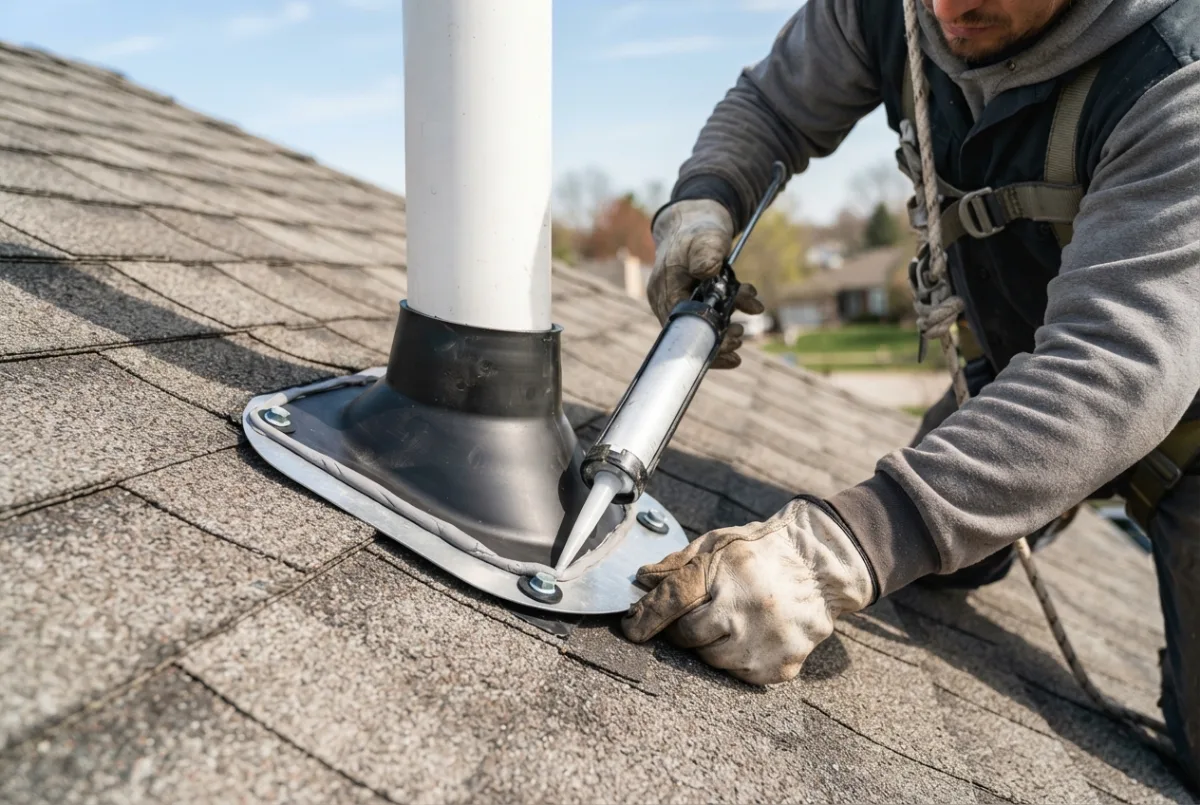
The rubber collar around a plumbing vent is the single most common leak source on a roof of this age. The rubber is the shortest-lived component up there, and Central Valley summers are unkind to it. It cracks in a ring around the pipe, water runs straight down the outside of the vent, and the ceiling stain appears in a bathroom or hallway. It is a cheap, quick repair, and it is worth checking first on almost any mystery leak.
Valley and wall flashing
Valleys carry concentrated water. Where two roof planes meet, or where a roof plane runs into a wall, the flashing does the waterproofing and the shingles are just cover. Sealant used in place of proper flashing detail is a common builder shortcut, and sealant has a much shorter life than metal. When the caulking at a sidewall or chimney has gone hard and cracked, it is doing nothing.
Wind-lifted and brittle shingles
Asphalt shingles seal to each other with an adhesive strip that softens in heat and bonds. After enough summers the asphalt loses its flexibility and those bonds fail. A shingle that is no longer sealed down lifts in wind, and once one lifts the ones above it are exposed. This is why wind damage rarely appears as a single missing shingle in isolation.
Tile: the underlayment, not the tile
Concrete tile is common on Elk Grove homes and it confuses a lot of homeowners. The tile is a rain shield with a very long life. The waterproofing is the underlayment beneath it, and that has a much shorter life. A tile roof can look perfect from the street while the layer doing the actual work has failed. Repairing a tile roof properly means lifting tile, working on what is underneath, and setting it back without cracking the surrounding pieces.
One thing worth checking before you call anyone
Walk the perimeter from the ground after rain and look at where water is coming off the roof. Gutters that overflow at a specific corner, or a downspout that runs dry while water sheets over the fascia next to it, usually mean a blockage rather than a roof failure. It is a five-minute check that occasionally saves a service call entirely.
How a repair visit usually goes
A contractor coming out for a leak is doing three things: finding the entry point, assessing whether the decking underneath has been compromised, and forming a view on whether the rest of the roof has life left in it.
- Interior first. Where the stain is, how large it is, whether it is active, and what is directly above it in the attic. Attic access tells a contractor more than the roof surface does, because water tracks are visible on the underside of the decking.
- Then the roof surface, working uphill from the point that lines up with the interior stain. Penetrations, flashing, valleys and any area where the covering has been disturbed.
- Decking condition. Soft or delaminated sheathing under a long-running leak changes the job. It is also the most common source of a price increase mid-repair, because it cannot be seen until the covering is off.
- The repair or replace conversation, if the roof is old enough to warrant it. A good contractor will tell you when a repair is a stopgap.
What repairs cost, and why nobody can quote one over the phone
Roof repair pricing is driven by access, materials and how much has to come apart, and none of those are knowable from a description. A pipe boot on a single-story with a walkable pitch and a tile repair on a steep two-story are not the same job even though both are described as a leak repair.
The factors that move a repair price here, roughly in order of impact:
- Pitch and height. A roof that cannot be walked needs staging, harnesses or both. Two-story steep tile is the expensive end.
- Decking damage. Replacing compromised sheathing turns a surface repair into a structural one.
- Material matching. Twenty-year-old shingles are usually discontinued. A repair that has to blend into a visible slope is harder than one on a back elevation.
- Tile handling. Concrete tile is heavy and brittle with age. Access across a tile field causes breakage, which gets factored in.
- Number of separate areas. Three small repairs in three places cost more than one repair three times the size, because the setup happens three times.
Be careful with a very low repair quote on an old roof
A repair priced well under everyone else on a roof past twenty years is sometimes a contractor planning to seal the symptom rather than fix the cause. Sealant over a failed flashing detail looks like a repair and holds through one season. Ask specifically what is being replaced, not just what is being fixed.
When the permit rules come into play
Elk Grove requires a building permit for roofing work over 100 square feet, and for any new roof covering or overlay where the combined material weight exceeds 3-1/2 pounds per square foot. Going from a light covering to tile triggers a structural analysis before the permit issues, because tile and comparable products run over 350 pounds per square.
Most genuine repairs sit below that line. The reason it matters on a repair page is that repairs sometimes grow. If the contractor opens up an area and the scope expands past a hundred square feet, the job has crossed into permit territory and should be handled that way rather than quietly continued.
Checking the contractor before the work, not after
California requires a CSLB C-39 roofing license for any roofing work where labor and materials together exceed $500. That threshold is low enough that it covers essentially every repair worth hiring out. Licensed contractors are also required to display their license number in their advertising, which gives you a fast screening test: an ad, truck or website with no license number on it is a question worth asking before anything else.
The license number can be checked free on the CSLB website in under a minute, and it shows whether the license is active, what classification it holds, and whether the bond and workers compensation coverage are current.
Common questions
How long does a typical roof repair take?
Most single-point repairs, such as a failed pipe boot or a length of flashing, are a few hours of work. Repairs that involve opening up decking, or that cover several separate problem areas, can run a full day. The scheduling delay is usually longer than the repair itself, especially in the weeks after a storm.
Do I need a permit for a roof repair in Elk Grove?
Small repairs generally do not need one. The City of Elk Grove sets the threshold at 100 square feet, so repairs above that, and any re-roof or overlay using material heavier than 3-1/2 pounds per square foot, need a permit. If a contractor tells you a large repair needs no permit, confirm it with the Elk Grove Building Division directly on (916) 478-2235.
Can a repair be done on a roof that is already 20 years old?
Physically, usually yes. Whether it is worth doing is a different question. On a roof near the end of its service life a repair buys time rather than solving anything, and shingles that have gone brittle in Valley summers are difficult to work on without damaging the surrounding area. Age is the main input in the repair or replace decision.
Why does the leak stain not line up with the damaged spot?
Water enters at the failure point, then travels along the underside of the decking, down a rafter or along the top of the ceiling drywall before it drops. On a pitched roof the entry point is almost always further up the slope than the stain. Chasing the stain instead of the entry point is the most common reason a repair does not hold.
Will a repair void the roof warranty?
It depends on who does the work and what the warranty covers. Manufacturer material warranties usually survive a competent repair. Workmanship warranties from the original installer often do not survive another company working on the roof. If your roof is still inside a workmanship warranty period, check the terms before booking anyone else.
Sources
Every local figure on this page comes from one of these. Check them yourself.