The signs that actually mean the roof is finished
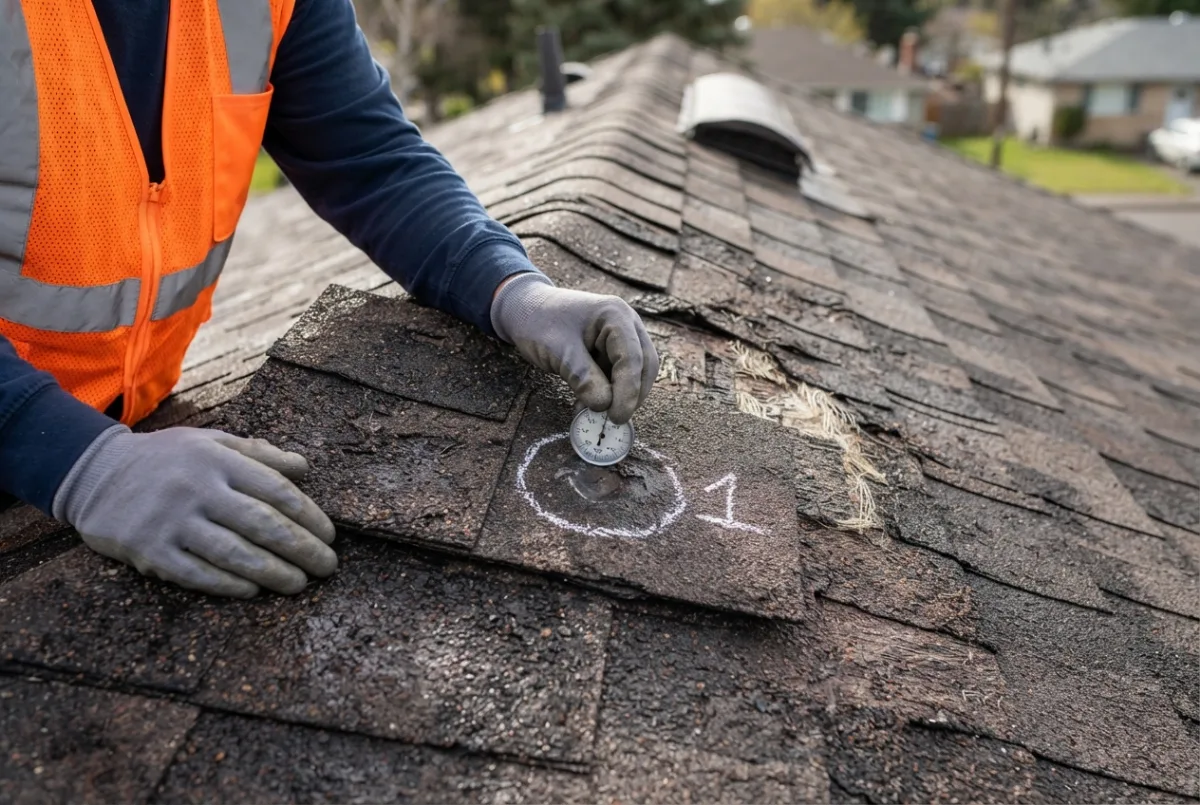
Granule loss across whole slopes
Granules are the layer that protects asphalt from UV, and UV is what kills shingles in this climate. Losing them is not cosmetic wear, it is the removal of the shingle's only defence.
Look for bald patches where the black mat shows through, a roof that has gone noticeably lighter or patchier in colour, and granule accumulation in the gutters and at the bottom of downspouts. South and west slopes get there first here, so it is normal for one elevation to be clearly worse.
Curling, cupping and cracking across the field
Shingles that have lost their flexibility lift at the edges or crack through. In one small area this is damage. Across whole slopes it is the asphalt itself having dried out, which is not reversible and not repairable.
Leaks in unrelated places
This is the strongest signal of all. One leak is an event with a cause. Three leaks in different parts of the house within a season or two is a condition, and each repair buys less time than the last. If you have had a roofer out more than twice in two years for different spots, the arithmetic has probably already changed.
A visible dip or sag in the roof line
Sight along the ridge and the slopes from the ground. Waves, dips or a sagging ridge suggest a problem in the decking or the structure rather than the covering, and that is the one on this list to act on rather than monitor.
Daylight or staining in the attic
Daylight through the roof boards is unambiguous. Widespread staining across the underside of the sheathing, rather than one localised patch, means water has been getting in over a broad area and for some time.
The Elk Grove timing problem
The median local home was built around 2000 and 37.4% of the housing went up between 2000 and 2009. Those roofs went on together and reach the end together, which means when your street starts needing roofs, yours is probably not far behind. It also means contractor availability tightens at exactly the moment your neighbours are all calling.
Signs that are commonly misread
- Dark streaking. Usually algae, mostly on north-facing slopes, and largely cosmetic. It looks like decay and is not.
- A few missing shingles after wind. Ordinary storm damage, and a repair, unless the roof was already near the end.
- One ceiling stain. Most often a flashing detail, very often a cracked pipe boot, not the roof covering.
- Moss. Worth removing because it holds water and lifts edges, but it is a maintenance item rather than a verdict.
- Age by itself. A number is a probability, not a diagnosis. Plenty of well-ventilated roofs outlive expectations and plenty of baked ones do not reach them.
Tile is the exception to all of this
Almost every sign above assumes a covering that shows its age. Concrete tile does not. It can look essentially unchanged for decades while the underlayment beneath it, which is the actual waterproofing, reaches the end of its life.
On a tile roof the questions are different: how old is the underlayment, is there staining in the attic, and has anyone lifted tiles to look. Given how much Elk Grove tile dates from the 2000s, a great many local tile roofs are in exactly that window now. See tile roof replacement.
What to do with the answer
If you are seeing one or two items from the first list, get an inspection before deciding anything. If you are seeing several, start collecting quotes while the weather is good rather than waiting for the storm that forces the issue.
The decision framework itself, including the arithmetic on whether another repair makes sense, is in repair or replace.
Questions about roof age and condition
Can I tell anything useful from the ground?
More than you would think. Granule loss, curling edges, uneven colour between slopes, sagging lines and moss are all visible with binoculars from the garden. What you cannot assess from the ground is the underlayment, the flashing detail or the decking, which is where the expensive answers live.
How much granule loss is normal?
Some granules in the gutter after a new roof is normal and settles within months. Granules accumulating in the gutter on a ten or fifteen year old roof is different, and bald patches where the black mat shows through are conclusive. Once the mat is exposed, the shingle has lost its UV protection and degrades quickly from there.
My roof looks fine but it is 25 years old. Should I replace it?
Not on age alone, but it is a good reason to have it looked at properly rather than waiting for a leak. Age raises the probability of failure without proving it, and the useful thing about acting early is that it happens on your schedule instead of during the first storm.
Does one leak mean the whole roof is finished?
No. A single leak is usually a detail: a pipe boot, a flashing, storm damage in one place. What signals a finished roof is leaks appearing in unrelated locations within a season or two, because that is the covering itself giving up rather than one component failing.
Will a tile roof show any of these signs?
Mostly not, which is the problem. Concrete tile looks much the same at twenty-five years as it did at five, while the underlayment beneath it quietly reaches the end. On tile, ignore the surface and go by the age of the underlayment and whether there is staining in the attic.