What flashing is, and where yours is
Flashing is the material, usually metal, that seals the places where the roof stops being a simple slope. Anywhere the roof meets a wall, changes direction, or is interrupted by something passing through it, there is a flashing detail doing the waterproofing.
Working down the list of what is on a typical house here:
- Pipe boots. The collars around plumbing vent stacks. Typically a rubber or synthetic gasket in a metal base, and the most common single point of failure on a residential roof in this climate.
- Valley flashing. Metal running where two roof planes meet. It carries more water than any other part of the roof, so it is unforgiving of debris and poor installation.
- Step flashing. Individual pieces woven into the courses where a roof slope runs alongside a wall. Should be one piece per course, interleaved. Frequently replaced with a single long strip and sealant, which is faster to install and fails sooner.
- Apron and headwall flashing. Where a roof slope runs into a wall face on.
- Counter-flashing. At chimneys, the upper piece let into the masonry that covers the top of the base flashing. If it is surface-mounted and caulked rather than let in, it is on a clock.
- Kick-out flashing. The small diverter at the bottom of a roof-to-wall junction. Often missing entirely.
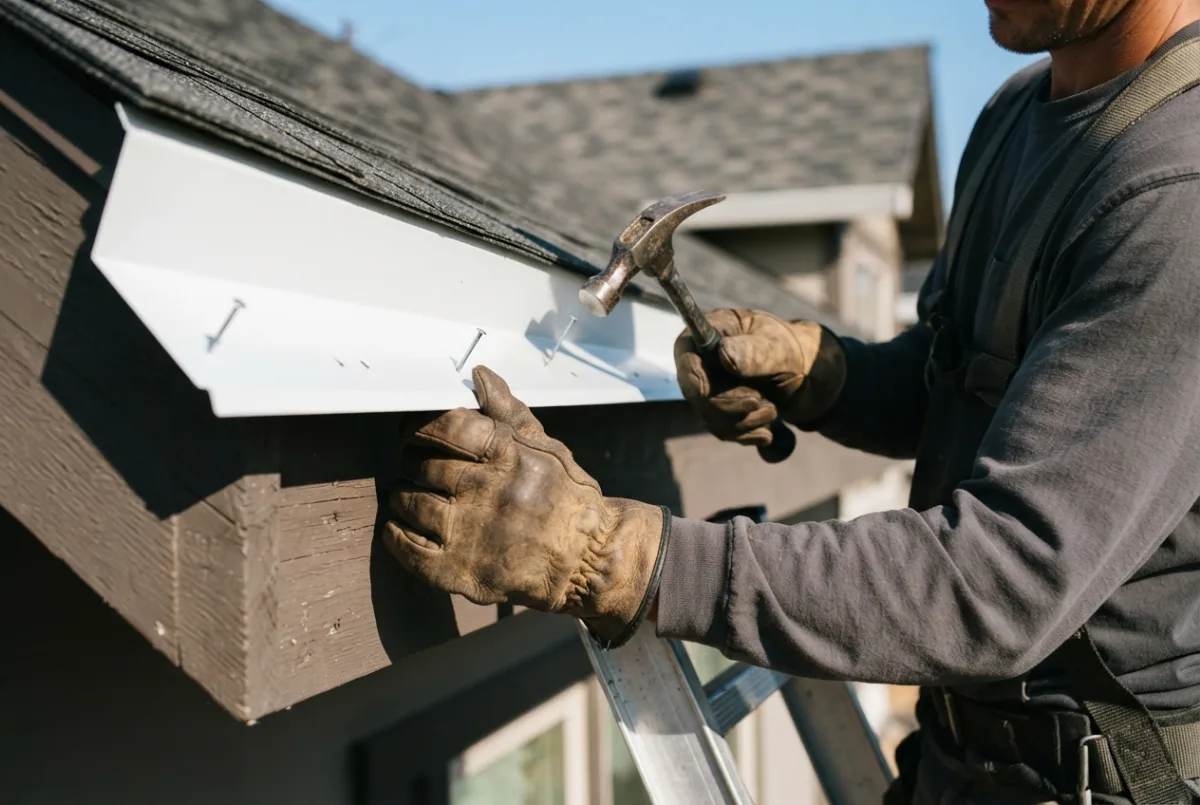
- Drip edge. Along eaves and rakes, directing water into the gutter rather than behind it and onto the fascia.
Why pipe boots go first in Elk Grove
Of everything on that list, the rubber pipe boot collar is the one most likely to be the reason a roof that is otherwise fine is leaking.
The reason is sun. The collar is a flexible synthetic component sitting exposed on a roof that spends months under high UV and serious summer heat. That is precisely what degrades rubber. It hardens, then it cracks around the pipe, and then it lets water straight down the outside of the vent stack into the ceiling below.
The timeline is the useful part: the collar frequently fails well before the surrounding roof covering is anywhere near the end of its life. So a leak on a mid-life roof, appearing near a bathroom or kitchen, is worth checking here before anyone starts discussing replacement. It is also, mercifully, one of the cheaper repairs on a roof.
How to narrow it down from inside
Find where the stain is, then work out what is directly above it and slightly up-slope. A stain near a bathroom usually means a vent stack. A stain along an exterior wall on an upper floor usually means a wall junction or a missing kick-out. A stain in the middle of a room with nothing above it points at a valley or the roof field. This does not diagnose it, but it tells a roofer where to start.
Valleys, and why debris matters there
A valley collects the water from two roof planes and moves all of it through one channel. It is the highest-volume, highest-velocity part of the roof, and anything that obstructs it causes water to back up sideways under the covering.
In practice the obstruction is leaves and needles. This is why valley clearing is one of the few genuinely high-value maintenance tasks, particularly on roofs with mature trees over them. A valley that is clear will usually outlast the roof. A valley that holds a wet mat of debris through every wet season will not.
Chimneys are the hardest detail on the house
A chimney interrupts the roof with a large masonry obstruction that water has to get around on all four sides, and masonry moves differently from the roof structure it passes through. It needs base flashing, counter-flashing let into the masonry, and a cricket on the upslope side of anything wide enough to dam water.
Most chimney leaks come down to one of three things: counter-flashing that was caulked to the surface instead of let into a cut joint, no cricket where there should be one, or deteriorated mortar letting water in through the masonry itself rather than the flashing at all. The third one is not a roofing repair, which is worth knowing before you pay a roofer to solve it.
Repair, or replace with the roof
Isolated flashing repairs are usually worth doing on their own. A cracked pipe boot, a section of failed step flashing, a missing kick-out: all are contained jobs that fix a real problem for a small amount of money.
Where it changes is when flashing across the roof has reached the same age and is failing in several places at once, on a covering that is also near the end. At that point individual repairs are chasing a general condition, and the flashings should be replaced as part of a replacement instead. Make sure they are: new flashing is a normal part of a re-roof, and reusing the old metal is a corner that gets cut.
Flashing questions
Why does flashing fail before the roof does?
Because it is a different material doing a harder job. Flashing sits at every junction and penetration, expands and contracts against materials that move at a different rate, and in the case of pipe boots is often rubber sitting in direct sun. The roof field has an easy life by comparison.
Can flashing just be sealed instead of replaced?
Sealant is a legitimate repair in specific places and a poor substitute for correct metal everywhere else. A bead of sealant along a step flashing that was installed wrong will hold for a season or two and then fail at the same spot. If a quote is mostly sealant, ask what is underneath it.
Does flashing get replaced during a re-roof?
It should be, and this is worth checking on a quote. Reusing old flashing on a new roof saves a small amount of material and puts the oldest components back under the newest covering. Valley metal, pipe boots and anything at a wall should be new. Chimney counter-flashing is sometimes reused where it is sound and properly let into the masonry.
What is a kick-out flashing?
A small piece at the bottom of a roof-to-wall junction that kicks water away from the wall and into the gutter. It is frequently missing on houses of every age, and when it is missing water runs straight down inside the wall cladding instead. The damage shows up as rot behind siding rather than as a ceiling stain, so it goes unnoticed for years.
How long should a pipe boot last?
Less time than your roof, which is the point. The rubber collar degrades under UV, and in this climate that clock runs faster than in milder places. It is common for a boot to crack well before the surrounding shingles are anywhere near done, which is why they are one of the first things worth looking at on a mid-life roof.