Start with what the stain can tell you
Before going anywhere near a roof, get what you can from inside. Three things are worth recording, and all of them help whoever ends up diagnosing it.
- Exactly where it appears. Photograph it, and note what is directly above it: a bathroom, an exterior wall, the middle of a room with nothing over it.
- What conditions produce it. Every rain, or only heavy rain? Only when wind is driving from a particular direction? Wind-dependent leaks point at vertical details like wall junctions and chimneys rather than at the roof field.
- Whether it is new. A fresh clean stain behaves differently from a ring-within-a-ring stain that has dried and re-wet over several seasons.
Work upslope, not straight up
The one rule that makes this tractable: water runs downhill. The entry point is always at or above the height of the stain, and in practice it is nearly always further up the slope.
So take the position of the stain, project it up onto the roof, and then keep going up the slope from there. Anything on that line is a candidate, and penetrations are candidates before the open field of the roof is.
What is above the stain?
A stain near a bathroom or kitchen usually means a plumbing vent stack, and the rubber collar on those is the most common single failure on a roof in this climate. A stain along an upper exterior wall usually means a roof-to-wall junction or a missing kick-out. A stain in the middle of a ceiling with nothing above it points to a valley or a fastener path.
The attic is where this usually gets solved
If the attic is accessible and has safe footing, this is the highest-value fifteen minutes in the whole process. You are looking for the trail rather than the destination.
- Go up during daylight with the lights off. Daylight visible through the roof is the fastest possible answer and it does happen.
- Find the wet area, then follow it up. Staining on the underside of the sheathing and dark tracks down a rafter both point uphill toward the entry.
- Look at the nail points. Rusted or wet nail tips in one area tell you water is arriving there. Rusted nails everywhere is a ventilation issue rather than a leak, and is worth knowing separately.
- Check around every penetration. Vent stacks, bath fans, flue pipes, the framing around skylights.
- Feel the insulation. Damp or compacted insulation marks where water has been landing, and it holds that evidence long after the surface has dried.
Take photographs of anything you find. A roofer who arrives already knowing that the sheathing is stained two rafter bays over from the bathroom vent is starting from a much better place.
The complication on a tile roof
On tile, this all still applies, but the entry point and the failure are usually different things. Water that gets past a cracked tile is supposed to be caught by the underlayment below it. A leak means that layer has failed somewhere, and where it failed can be well away from any visible tile damage.
It also means the visible broken tile you spotted from the driveway may be entirely innocent. See tile roof repair for how that changes the diagnosis, and do not go up there to check: walking concrete tile creates the next problem.
Leaks that are not roof leaks
A reasonable share of ceiling stains have nothing to do with the roof, and it is worth ruling these out before paying anyone to work on one.
- Condensation. Appears on cold mornings without rain, often over bathrooms. A ventilation problem, covered under roof and attic ventilation.
- Plumbing. A supply or waste leak in a wall or upstairs floor. The giveaway is that it does not correlate with rain at all.
- Air-conditioning condensate. Attic-mounted units with a blocked condensate line produce a ceiling stain that appears in hot weather, which is the opposite pattern from a roof leak.
- Gutters and fascia. Water overflowing a blocked gutter can run behind the fascia and into the structure without ever involving the roof covering.
When to stop and call someone
Stop at the point where the next step involves being on the roof. That is where the information gathering ends and the risk begins, and a wet or storm-damaged roof is not a good place to learn.
If water is actively coming in now, deal with containment first: roof leak help covers the first twenty minutes, and emergency roof repair covers getting it stopped temporarily when the weather will not wait.
Questions about tracing leaks
How far from the leak can the entry point be?
Further than most people expect. Water can run several feet along a rafter or across the top of the ceiling before it finds a seam to drop through, and it always travels down-slope and sideways rather than up. Treat the stain as the end of the journey, not the start.
Is it worth going into the attic myself?
Yes, carefully, and it is the single most useful thing a homeowner can do. Stay on the joists, take a torch, and look for staining, damp insulation or daylight. You are gathering information for whoever comes out, not fixing anything. If the attic has no safe footing, skip it.
Can I use a hose to find it?
A water test works, but only if done slowly and in sections, starting low on the roof and working up, with someone inside watching. Soaking the whole roof at once tells you nothing because you cannot tell which area produced the result. It also needs two people, and one of them on a roof, which is the part worth handing over.
The stain has stopped growing. Did it fix itself?
No. It stopped raining. Nothing on a roof repairs itself, and a dry gap between storms is the best time to get it looked at, because a roofer can work safely and is not competing with every other emergency call in the county.
Does infrared actually find leaks?
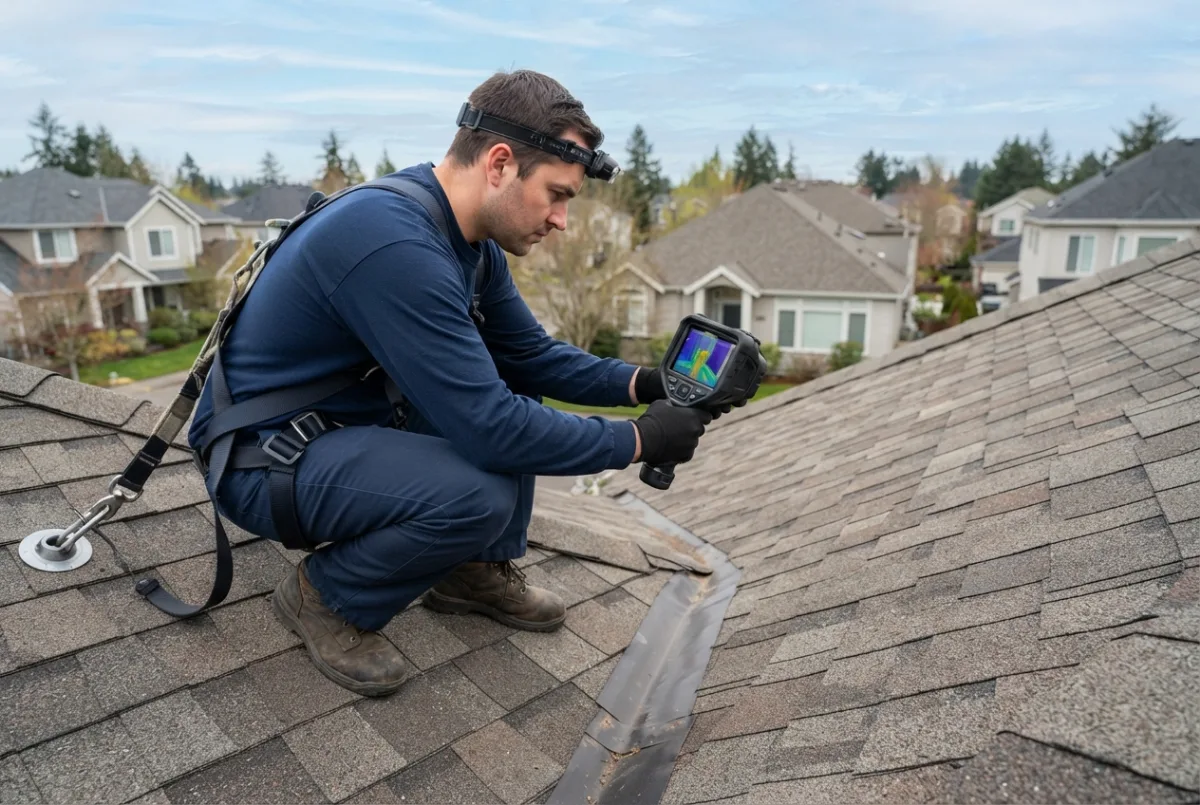
It finds moisture, which is not quite the same thing but is genuinely useful. Thermal imaging picks up temperature differences caused by wet material, so it maps where water has gone rather than where it came in. On a low-slope roof, that mapping is often the fastest route to the answer.