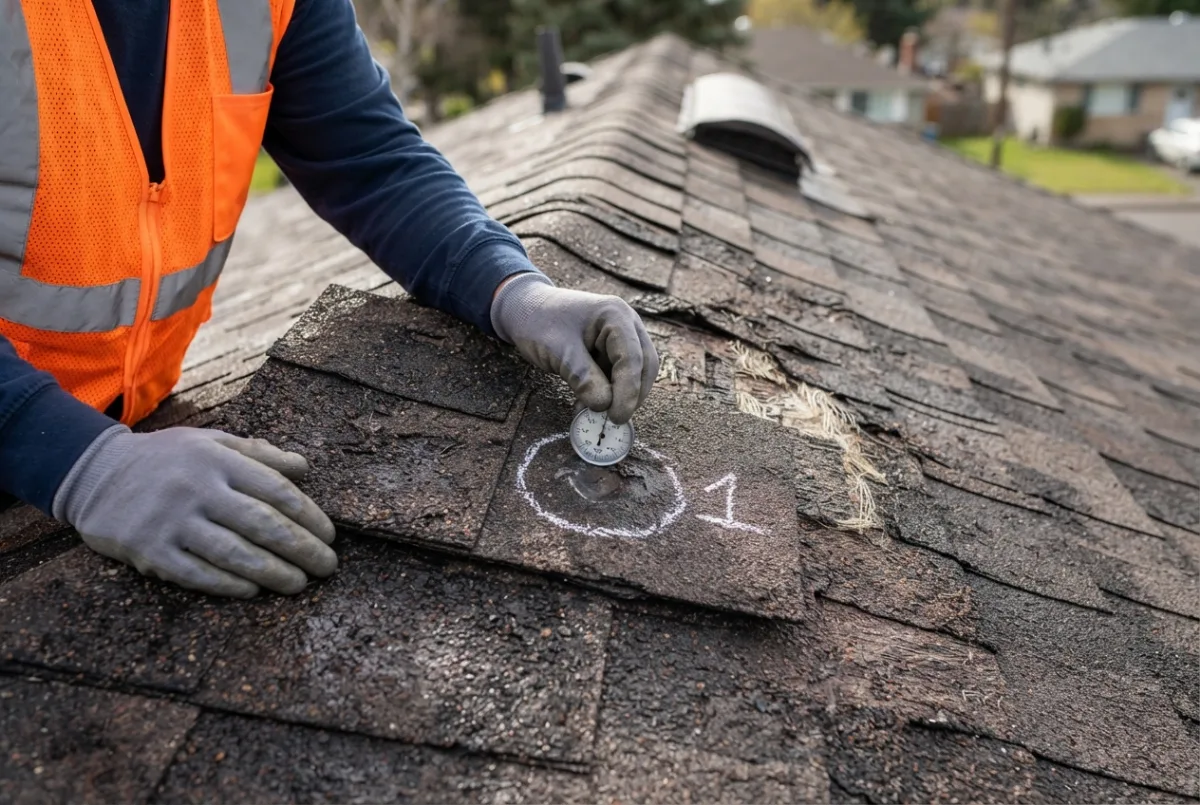
What Sacramento Valley storms actually do to roofs
Roofing content written for the Midwest is mostly about hail. That is not the damage pattern here. Elk Grove sits in a valley climate where the roofing threat arrives as concentrated winter frontal systems and the wind that comes with them, often channeled through the delta gap. Rain does not fall evenly across the year, it shows up in bursts, and a roof can take a large share of its annual water load across a handful of days.
That produces a distinctive set of failures.
Wind uplift along edges and ridges
Wind does not usually tear shingles off the middle of a roof plane. It gets under an edge, a rake, an eave or the ridge, and peels inward. Damage tends to run in a strip. Ridge cap shingles are the most exposed component on the whole roof and frequently the first to go.
Creased shingles that look fine from the ground
A shingle can be lifted by wind, folded back, and dropped into roughly its original position. It looks intact from the driveway but the fold has broken the mat and the seal is gone. It will leak and it will lift again in the next wind event. This is the damage type that gets missed in a quick look and then argued about with an insurer later.
Age makes the same wind worse
Shingles hold themselves down with an adhesive strip that bonds in heat. After twenty Central Valley summers the asphalt has lost flexibility and many of those bonds have already let go. A roof from the mid-2000s takes wind damage at speeds that would not have touched it when it was new, which is why a single storm can produce very different outcomes on two houses of the same age on the same street.
Debris and overhanging limbs
Branch impact concentrates damage in one spot and can go through the covering into the decking. Even where nothing punctures, a limb dragging across a roof scours granules off the shingle surface, which shortens its life without leaving obvious damage.
Drainage failures that present as roof leaks
A large share of post-storm water intrusion is not a roof failure at all. Gutters packed with debris back water up under the bottom course of shingles. Valleys that cannot clear fast enough overflow sideways. On low-slope sections, ponding finds every marginal seam. These are worth checking before assuming the roof covering has failed.
Do not get on the roof
A storm-damaged roof is wet, may have lost fasteners, and can have decking that is sound to look at and not sound to stand on. Ground-level photographs with a zoom, plus attic photographs of the underside of the decking, cover what you need for both an assessment and a claim. Leave the roof to someone with fall protection.
Document it properly, in this order
- Photograph before you touch anything. Wide shots of each elevation from the ground, then zoomed shots of specific damage. Include something in frame that gives scale.
- Get into the attic. Photograph any daylight through the decking, wet insulation, water tracks on rafters, and stains on the underside of the sheathing. This is the evidence that establishes water actually entered.
- Photograph the interior. Ceiling stains, wet drywall, damaged contents. Date matters, so take them the same day.
- Note the date and the weather. Insurers work from a date of loss. Write it down while you are certain of it.
- Then take emergency measures to stop further water entry, and photograph those too. Keep receipts for tarps, buckets and anything else you buy.
Temporary protection, and what it is for
Tarping is not a repair. It is a way of keeping water out of the structure until a proper repair can be scoped and scheduled, and it matters most when the next front is forecast before a crew can get to you.
Done properly, a tarp runs over the ridge rather than stopping short of it, is secured against wind on all edges, and is fastened in a way that does not create new penetrations in sound roofing. A tarp that is weighted with whatever was in the garage will move in the first gust and can make things worse. If water is coming in right now, the emergency roof repair page covers the first hour in more detail.
Insurance, without the folklore
Storm damage claims are ordinary. The parts homeowners get wrong are usually procedural rather than technical.
- Sudden damage is the covered category. Wear, age and deferred maintenance generally are not. A twenty-year-old roof that finally failed in a storm sits in genuinely contested territory, and the strength of your before-and-after documentation is what decides it.
- You are normally expected to mitigate. Reasonable steps to prevent further damage are usually a policy requirement, not an optional extra, and reasonable costs of doing so are often recoverable.
- Compare the likely repair against your deductible before filing. A claim that lands near or below it may not be worth making.
- An adjuster and a roofer are looking at different things. The adjuster is scoping a covered loss. The roofer is scoping a repair. Having the roofer present at the adjuster inspection is common and generally useful.
Storm chasers, and how to screen them in sixty seconds
After any significant weather event, out-of-area crews work neighborhoods door to door. Some are legitimate. The screen is simple: ask for the CSLB C-39 license number and check it yourself on the CSLB site before anyone goes up a ladder. California requires that license for roofing work over $500 and requires the number to appear in advertising. Treat an offer to waive or absorb your deductible as a reason to end the conversation, and never hand over a large payment before work has started.
Getting it looked at
After a storm the whole city calls at once, which is the single biggest cause of delay. If water is actively coming in, say so when you call, because that changes how the job is triaged. Call (916) 659-9524 and describe what you are seeing.
Storm damage questions
What counts as storm damage on a roof here?
In the Sacramento Valley it is overwhelmingly wind rather than hail: lifted or creased shingles, missing ridge cap, torn flashing, and debris impact from branches. Damage often appears as a strip along one edge or slope rather than scattered across the roof, because wind gets under the covering at an edge and works inward.
Should I get on the roof to check after a storm?
No. A roof that has just been damaged is the least safe time to be on it: wet, possibly missing fasteners, and with compromised decking you cannot see from above. Everything you need for an initial assessment and an insurance claim can be photographed from the ground and from inside the attic.
Should I call insurance or a roofer first?
Document first, then either. Photographs taken before anything is touched are what protect the claim. Emergency measures to prevent further damage are normally expected of you and should be documented too, including receipts. If the damage is minor and likely below your deductible, a claim may not be worth filing at all.
Someone knocked on my door offering a free storm inspection. Is that normal?
Door-knocking after storms is common and not automatically a scam, but it deserves scrutiny. Get the CSLB license number, check it yourself on the CSLB site, and never let anyone onto the roof who cannot produce one. Be particularly wary of anyone offering to cover your deductible, which is not legal, or asking for a large payment before work begins.
How fast do I need to act?
Fast enough to stop water getting in, which usually means a tarp within a day or two, and faster if rain is forecast. The full repair can wait for a proper assessment. Most policies require you to take reasonable steps to prevent further damage, so delaying the temporary protection can itself become a problem.
Sources
Every local figure on this page comes from one of these. Check them yourself.