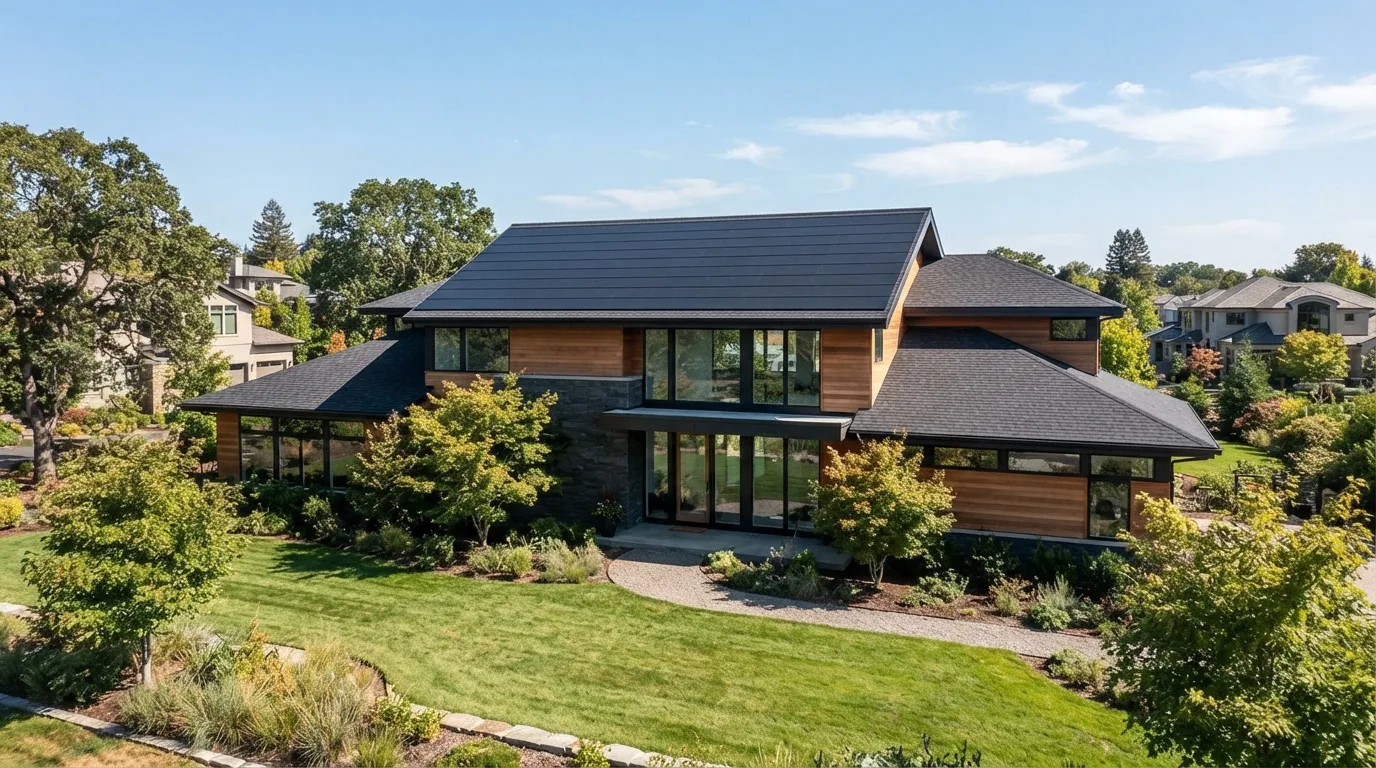
Where low-slope actually shows up here
86.1% of Elk Grove housing is detached single-family, and detached houses grow attachments. Patio covers get added. Porches get roofed. Rear rooms get extended under a shallow continuation of the existing roof, because a steeper one would have run into a window or a wall.
Each of those creates a low-slope section on a house whose main roof is a normal pitch. It is rarely designed as a low-slope roof, and often it is not covered as one either, because whoever built it simply carried the shingles across.
Why shingles fail on a shallow roof
Shingles are not a waterproof sheet. They are overlapping pieces that shed water downhill, and the overlap only works if water is moving fast enough to clear each lap before it can work sideways or backwards.
Drop the slope and water slows down. It lingers at the laps. Wind-driven rain pushes it uphill under the shingle. Debris holds moisture against the surface. None of this is a defect in the shingles, and replacing them with better shingles changes nothing, which is why these sections get repaired repeatedly without improving.
The diagnostic that settles it
Go out after heavy rain and look at where the water is a day later. A section that is still holding water has a slope or drainage problem, and no amount of sealing seams will fix that. A section that drains but leaks anyway has a membrane or detail problem. Those are two different jobs and it is worth knowing which one you are buying.
What belongs on a low-slope section instead
- Single-ply membrane. A sheet material, heat-welded or bonded at the seams, so the surface is continuous rather than overlapping. The seams and the penetrations are the parts that matter, because the field of the sheet rarely fails first.
- Modified bitumen. Asphalt-based sheet, torch or self-adhered, in multiple plies. Durable and forgiving of foot traffic, which matters if the section is one people actually walk on.
- Built-up roofing. The traditional layered system. Still found on older low-slope roofs around Sacramento, less often specified new on a residential patio cover.
On a small residential section the choice is usually driven by what it connects to and how it terminates against the wall of the house, rather than by the material's headline properties.
The transition is where it leaks
On these roofs the failure is very often not in the middle of anything. It is where the low-slope section meets the main roof, or where it dies into a wall.
That junction has to move water off the steeper roof, across the change in pitch, and away, without letting it get behind the wall covering. It needs proper flashing, a real termination and usually a counter-flashing into the wall. Done with sealant instead, it works for a couple of seasons and then does not. If your leak is at the back of a patio cover where it joins the house, that detail is the first place to look, and flashing repair covers what a correct one looks like.
Ponding, and why it is not just cosmetic
Standing water is heavy, it works at every seam continuously rather than during a storm, and in a Elk Grove summer it accelerates the breakdown of whatever it is sitting on. It also tells you something structural: either the roof never had adequate fall, or the deck has deflected over time and now holds a low spot.
Fixing ponding means changing the slope, usually with tapered insulation or by correcting the deck, rather than sealing the puddle. That is a bigger job than a patch, and a contractor who identifies it rather than coating over it is doing you a favour.
Flat and low-slope questions
My patio cover leaks but the main roof is fine. Why?
Almost always because the patio cover is shallower than the main roof and has the same covering on it. Shingles rely on gravity moving water off fast. On a near-flat section water sits, then wind pushes it back under the laps. The main roof is fine because it has the slope shingles need and the patio does not.
Is a flat roof actually flat?
It should not be. What gets called flat is low-slope, and it still needs a deliberate fall so water leaves. Genuinely level roofs pond, and standing water finds every seam eventually. If a low-slope section holds water for more than a day or two after rain, that is a drainage problem rather than a leak problem, and patching seams will not fix it.
Can a low-slope section be patched, or does it need replacing?
Membrane roofs patch well when the failure is a seam, a penetration or a puncture, and the rest of the surface is sound. What does not patch well is a membrane that has gone brittle across the whole area, or one that has been repeatedly coated to hide problems. Layers of old coating make a proper repair harder, not easier.
Does roof coating count as a repair?
Coating is maintenance, not a repair, and it is oversold. On a sound membrane with a minor surface issue it buys time and reflects heat. Applied over a failed membrane or standing water it hides the problem and makes the eventual replacement more expensive, because the coating has to come off too.
Do low-slope repairs need a permit?
Follow the same rule as the rest of the roof. The City of Elk Grove treats roofing work over 100 square feet as permit work, and a patio cover or addition is still roofing. Small seam repairs generally sit below that, but a contractor pulling a permit for the main roof should be including these sections in the scope.