Why so many of these are first re-roofs
Roughly 37.4% of Elk Grove housing was built between 2000 and 2009, and 86.1% of the stock is detached single-family. A large share of the re-roofs happening here are therefore the first one that house has ever had.
That changes the job in a practical way. On a second or third re-roof there is a record: someone has been on the decking before, previous work is visible, problems are known. On a first re-roof the sheathing has been covered since the house was framed. Tear-off day is the first time anyone sees it. Contractors quoting these jobs know that, which is why the decking line on the estimate matters more than almost anything else on it.
What happens, in order
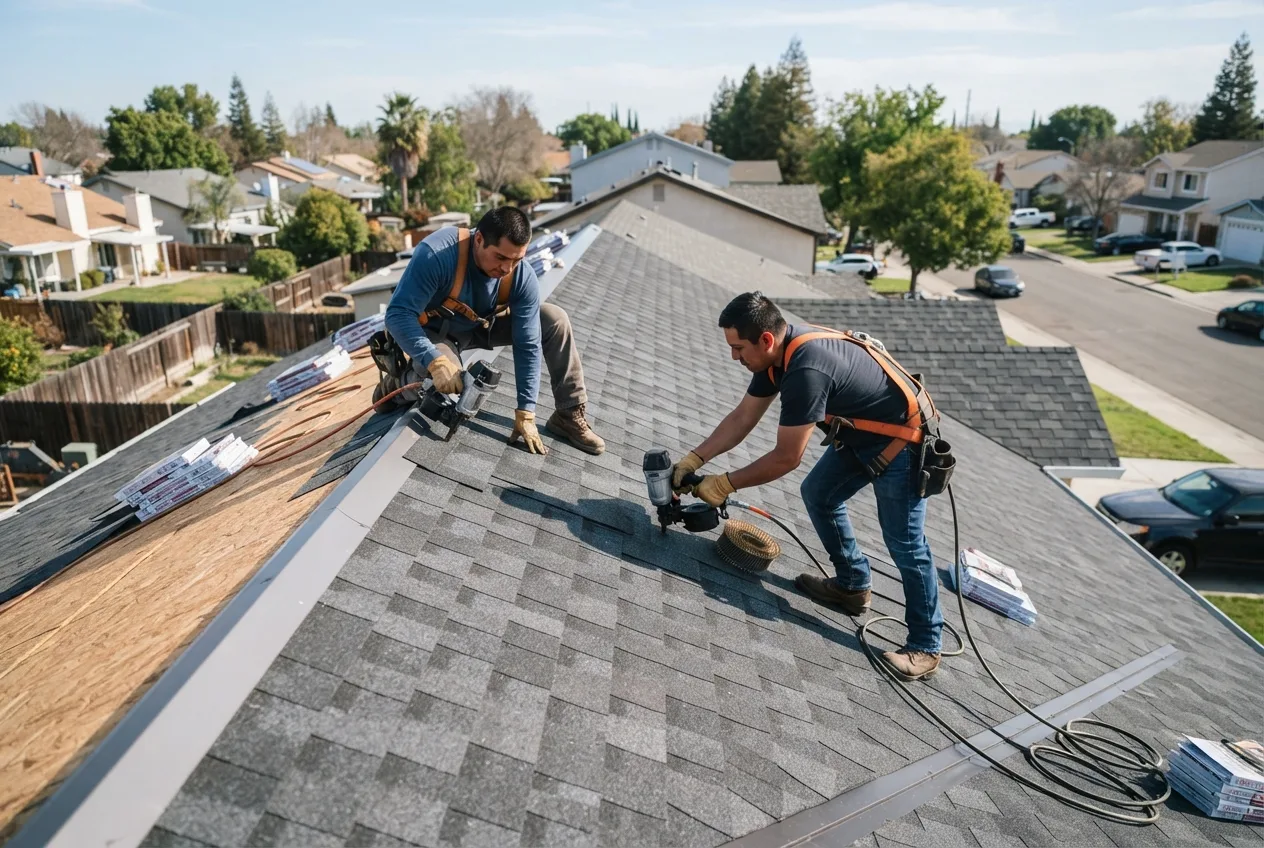
1. Tear-off
The existing covering comes off down to the decking. Elk Grove requires full removal where the existing roof is water soaked or has deteriorated past the point of being an adequate base for new roofing, and where the existing covering is slate, clay, cement or asbestos-cement tile. This is also the noisiest and messiest day by a wide margin, and the day to have cars out of the driveway and anything fragile off the attic floor.
2. Decking assessment and repair
With the roof open, the crew checks the sheathing for soft spots, delamination and water damage, and replaces what has failed. On a dry roof this can be nothing. Around a leak that has been running for a couple of winters it can be several sheets. This is the step that moves the final number.
3. Sheathing inspection
The city inspects the decking, nails and staples after installation and before anything covers them. Felt, paper, roofing or any other concealment has to wait until this passes. It is a fixed point in the schedule, not a formality at the end, and a crew that has not booked it can lose a day waiting.
4. Underlayment and dry-in
Underlayment goes down and the roof is weather-tight again. On a winter job this is the moment the risk drops sharply, which is why competent crews plan the work so that tear-off and dry-in happen on the same day rather than leaving a roof open overnight.
5. Flashing, covering and detail work
Valleys, sidewall and headwall flashing, penetrations and pipe boots, then the field material, then ridge. The flashing details are where roofs actually leak, and they are the easiest place to cut a corner invisibly. A new roof with reused, tired flashing is a common way for a job to come in cheap.
6. Final inspection and cleanup
Final city inspection, magnet sweep for nails, and debris removal. Ask specifically about the magnet pass over the driveway and lawn. It is the detail homeowners notice for months afterward.
The question that separates quotes
Ask every contractor: what happens if you find bad decking, how is it priced, and does this quote include an allowance for it? A quote with a stated per-sheet rate is being honest about an unknown. A quote that is silent on decking is not cheaper, it is just quieter about the same risk.
Material choice in a Central Valley climate
The dominant local consideration is heat, not storms. Long summers age roofing materials through thermal cycling, and the roof spends far more of its life hot than wet.
- Architectural asphalt shingles are the default replacement for most of the tract housing here, and are a straight swap that needs no structural work.
- Concrete tile is already on a large share of local homes. Where tile is being replaced with tile, the underlayment is usually the real project. Going from a lighter covering to tile is a different matter and needs a structural analysis first, because tile and similar composite products exceed 350 pounds per square.
- Metal holds up well to heat and has a long service life, at a higher up-front cost. It is worth pricing if you intend to stay in the house long term.
Material choice also interacts with the permit. Any change that increases the combined weight past 3-1/2 pounds per square foot needs to be handled at permit stage, not discovered mid-job.
Timing the work
Roofing here is seasonal in a way that affects both price and availability. Summer is reliable weather but peak demand and genuinely punishing working conditions. The weeks after the first serious winter front are the worst time to be looking, because everyone whose roof just failed is calling at once. Late spring and early autumn tend to be the easier windows for scheduling a planned replacement.
If your roof is functional and you are replacing it on a planned basis rather than an emergency one, you have the luxury of choosing that window. Use it.
Before you sign
Verify the CSLB C-39 license is active. California requires it for roofing work over $500, licensed contractors have to show the number in their advertising, and the free CSLB license check will confirm the classification, bond and workers compensation status in about a minute. On a job this size, that minute is the cheapest due diligence available.
Common questions
How long does a full roof replacement take?
A straightforward asphalt shingle re-roof on a typical single-family Elk Grove home is commonly a two to four day job, with the tear-off and dry-in usually happening on day one. Tile, complex rooflines, multiple stories and any significant decking replacement extend that. The sheathing inspection has to fit into the schedule as well, which can add a day if it is not booked ahead.
Do I have to tear off the old roof, or can the new one go over it?
It depends on what is up there. Elk Grove requires full removal of existing roof coverings where the existing roof is water soaked, has deteriorated to the point that it is not an adequate base for new roofing, or where the existing covering is slate, clay, cement or asbestos-cement tile. Even when an overlay is technically allowed, it hides the decking, and on a first re-roof the decking is the thing you most want eyes on.
Will I need a permit?
Yes, for a full replacement. Elk Grove requires a permit for roofing work over 100 square feet, and for any new installation or re-roof, overlays included, where combined material weight exceeds 3-1/2 pounds per square foot. Switching to tile from something lighter also triggers a structural analysis before the permit issues.
What is the sheathing inspection and can it be skipped?
It is a city inspection of the new decking, nails and staples after they are installed and before anything covers them. It cannot be skipped. Once felt or roofing goes over the decking the inspection can no longer be done, which is why it sits at a fixed point in the schedule rather than at the end of the job.
How much decking usually needs replacing?
On a roof that has not leaked, often very little or none. On one with a long-running leak, the damage is concentrated around the entry point and is not visible until tear-off. This is the single most common reason a final invoice differs from the quote, so ask up front how decking replacement is priced and whether the quote includes an allowance.
Sources
Every local figure on this page comes from one of these. Check them yourself.